Next.js 16 Guide: App Router, Turbopack and Best Practices
Practical guide to building modern Next.js 16 apps with the App Router, Turbopack, and patterns for routing, data fetching, and asset handling.
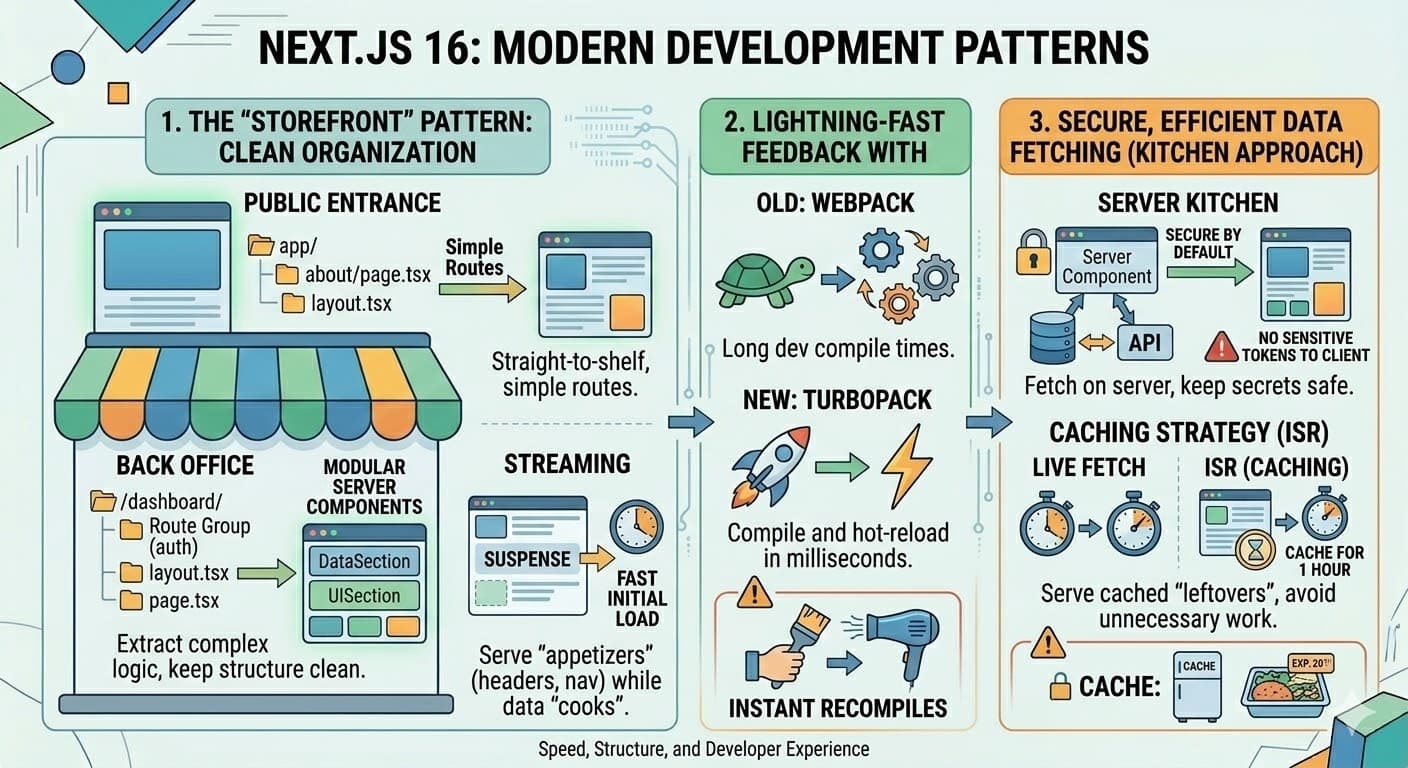
Next.js 16 emphasizes speed, structure, and developer experience. The core improvements – the App Router, server components, and Turbopack – let you build modern applications with fewer headaches. In this post I’ll translate those features into concrete patterns that you can apply today.
Organizing Your Application: the “Storefront” Pattern
Think of your application as a shop. The customer sees a clean storefront, while the back office handles complex work. Next.js’s file‑based routing and server components make it easy to keep the buyer’s path uncluttered.
- File-based routes are your straight‑to‑shelf pages (e.g.
/about). Create a file underapp/and you’re done. - Server components are the back‑office workers; they run on the server and can fetch data securely without shipping secrets to the client.
- Streaming lets you serve appetizers (headers, navbars) while the main course is still cooking. Wrap
components in
Suspensewith a fallback and React will progressively send HTML as it becomes ready.
Example structure
app/
├─ layout.tsx         # shared layout (navbar, footer)
├─ page.tsx           # homepage (client component)
└─ dashboard/
   ├─ layout.tsx      # dashboard layout, server component
   └─ page.tsx        # user dashboard page with Suspense
Lightning‑fast feedback with Turbopack
Turbopack replaces Webpack in the dev environment, compiling and hot-reloading code in milliseconds.
Analogy: painting with a hairdryer instead of waiting for each brush stroke to dry. Your edits show up almost instantly, keeping you in the flow.
No code changes are required; upgrade to Next.js 16 and use next dev. You’ll notice the instant recompiles.
Secure, efficient data fetching
The App Router encourages a “kitchen” approach: fetch data on the server and send only rendered HTML to the client. Sensitive tokens and database credentials never leave the server.
// server component: runs only on the server
async function ProfileData() {
  const res = await fetch("https://api.example.com/user", {
    next: { revalidate: 3600 }, // cache for one hour (ISR)
  });
  const data = await res.json();
  return <div>Welcome, {data.name}!</div>;
}
ISR (Incremental Static Regeneration) is the “leftovers” strategy: pre‑render a page and serve the cached copy until the timer expires, avoiding unnecessary work for data that rarely changes.
Putting it all together: a starter page
Here’s a minimal page that demonstrates streaming, server components, and caching.
import { Suspense } from "react";

// server component
async function ProfileData() {
  const res = await fetch("https://api.example.com/user", {
    next: { revalidate: 3600 },
  });
  const data = await res.json();
  return (
    <div className="p-4 bg-blue-50 rounded-lg shadow-sm">
      <h2 className="text-xl font-bold">Welcome, {data.name}!</h2>
    </div>
  );
}

function LoadingState() {
  return (
    <div className="p-4 bg-gray-100 animate-pulse rounded-lg">
      Loading your profile…
    </div>
  );
}

export default function Page() {
  return (
    <main className="max-w-xl mx-auto p-10">
      <h1 className="text-2xl font-bold mb-4">User Dashboard</h1>
      <Suspense fallback={<LoadingState />}>
        <ProfileData />
      </Suspense>
    </main>
  );
}
The layout above keeps the user-facing code simple, streams the profile component as it loads, and enforces a one‑hour cache on the server fetch.
Additional tips
- Route groups (
(auth)/dashboard) let you add middleware and layout logic without polluting the URL. - Static assets such as images should live in
public/; reference them with absolute paths (/logo.png). - Use the built-in
next/imagecomponent for automatic optimization and lazy-loading.
Conclusion
Next.js 16 brings powerful defaults that make modern web development a joy: server components for security, Turbopack
for developer velocity, and the App Router for clean architecture. Apply the “storefront” pattern, stream content with
Suspense, and adopt ISR, and you’ll have a codebase that scales from small prototypes to production systems without
becoming a tangled mess.
Happy building!